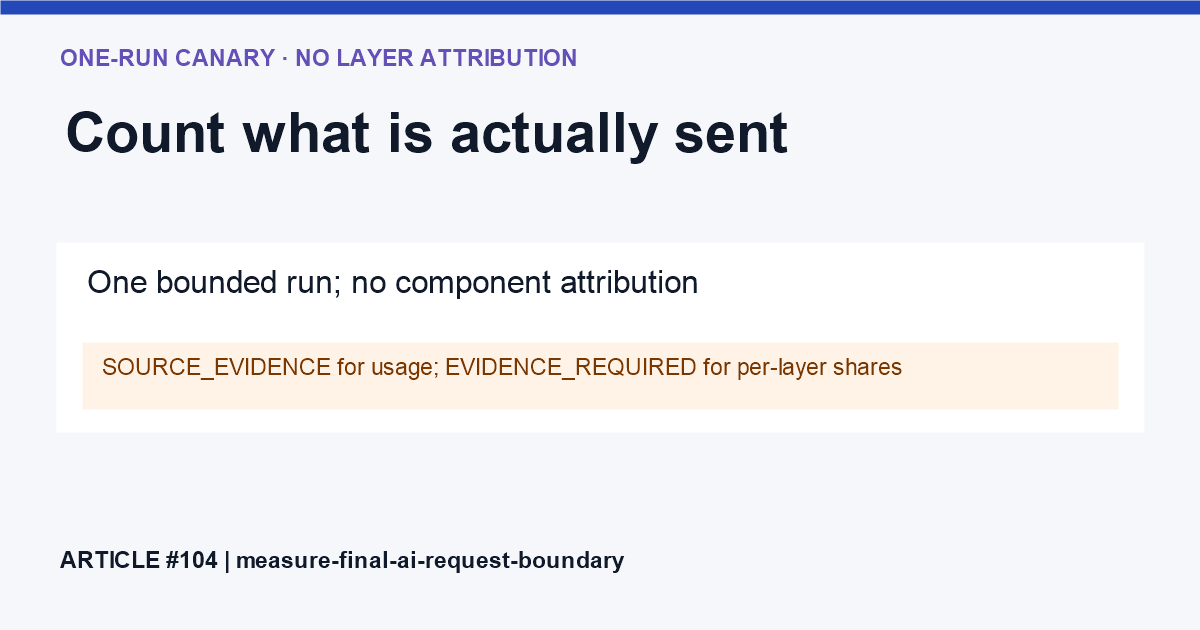
Classification: method guide anchored to one OBSERVED bounded run; no component-level attribution or general workload benchmark.
View the full infographic → · View this article
Counting the visible user prompt is not the same as counting the request the provider received. A wrapper may attach instructions, task context, history, tool definitions, formatting constraints or retry material. Provider-reported usage is the relevant boundary for provider-billed tokens.
Capture a reproducible request record
- Record timestamp, provider, endpoint, exact model and a non-sensitive run identifier.
- Capture the final serialized messages or a redacted reproducible representation.
- Record available tool schemas, response formats, routing and retry configuration.
- Save provider-reported input, cached input and output for each attempt.
- Link the final artifact and verifier outcome to the same job.
Redact secrets and private data before storing or publishing a request. Keep estimates from a local tokenizer distinct from provider-reported usage; tokenization rules can differ.
What one canary showed
One bounded GPT-6 Luna auth canary reported 13,289 input, zero cached input and 10 output tokens. It is one observation, not a general benchmark. It does not establish how much each instruction, tool schema or wrapper component contributed. That requires instrumenting components, not inferring them from the total.
Compare changes without losing correctness
Keep the task and acceptance test fixed. Change one context component at a time, record every attempt and verify the same quality threshold. Report request count, runtime, failures and accepted outputs with token totals. A smaller request is not an improvement if it omits a binding requirement or forces additional calls.
Read the full canary evidence and use the Context Cost Calculator for clearly labelled user-entered scenarios.