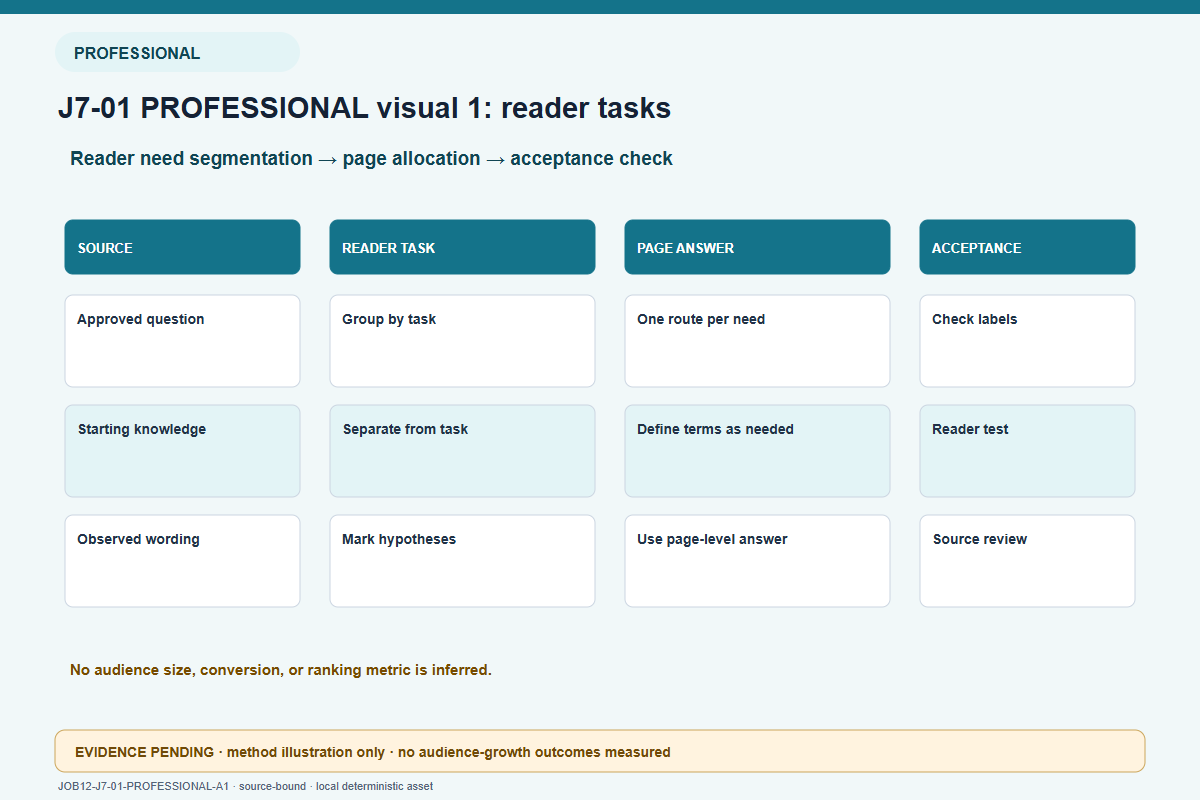
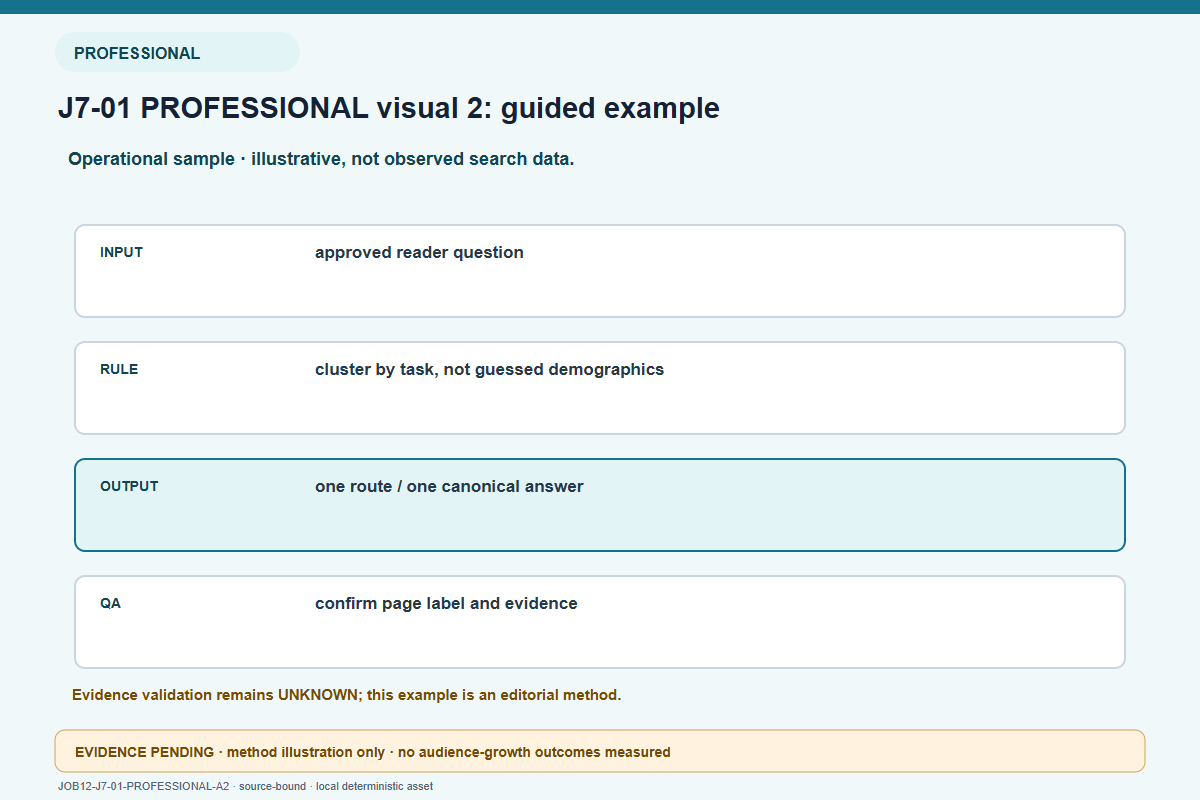
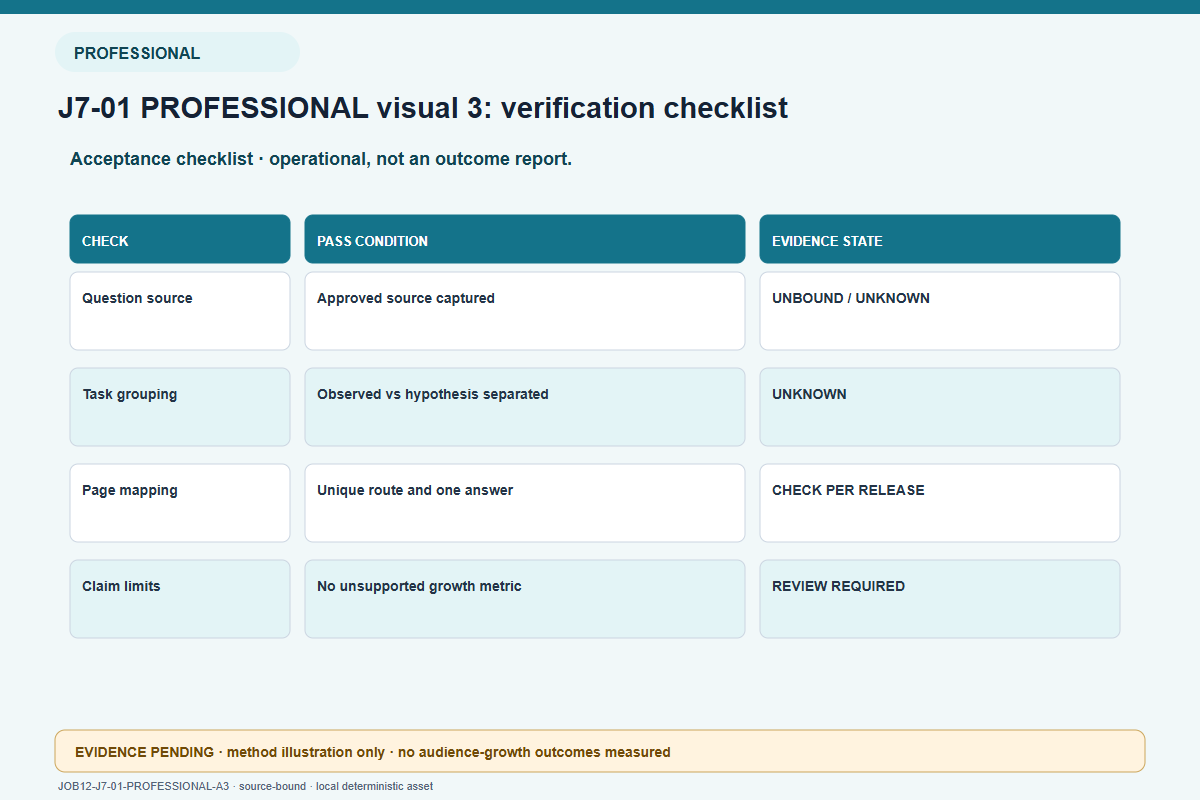
<strong>Quick answer:</strong> You can make one topic useful to more kinds of readers by answering genuinely different tasks clearly. This is a content-design method, not a guarantee that the audience will grow. Use the workflow, template and verification criteria below; platform-specific claims require current primary documentation.
Before you begin
Be concise and implementation oriented: inputs, outputs, owner, acceptance and recovery. Confirm the approved source revision and use only evidence you are permitted to share. This published method guide does not promise audience growth.
Steps
STEP 1
List questions from approved sources
STEP 2
group questions by task and starting knowledge
STEP 3
separate observed wording from hypotheses
STEP 4
record one job-to-be-done per group
STEP 5
map each to one canonical answer
STEP 6
validate labels with readers or query evidence
Professional working method
Treat this as an operational runbook: name the owner, revision, inputs, expected output, acceptance check and recovery path. Adapt platform-specific details to the version actually deployed.
Copy-and-paste template
Audience [ ] needs to [task]. Existing evidence: [source]. Starting knowledge: [ ]. Search wording observed: [ ]. Hypothesis only: [ ]. Canonical answer: [ ].Example
Partition reader needs by job-to-be-done, map each intent to one URL, and keep the shared claim layer consistent.
Common mistakes
- Using one level’s metadata or example unchanged for all audiences.
- Adding a result, conversion, cost or ranking claim without its evidence.
- Letting an image, tooltip or automation hide the source, limitation or approval state.
How to verify
- Check each step can be followed in the target environment.
- Confirm title/meta/H1 and query intent are unique among siblings.
- Map factual claims to approved source IDs and preserve limits.
- If an audience-specific asset is attached later, verify its alt text, nearby text equivalent, source and limits.
Frequently asked questions
<strong>Which inputs and owner should I define for research audience needs before writing?</strong>
Pick readers by the task they need to complete, not by invented demographics or guessed traffic. Record the source revision, owner and acceptance check before implementation.
<strong>What result claims are supported by this research audience needs before writing procedure?</strong>
Authorized first-party question/query data and privacy review; analytics before any audience-size or demand claim.
Terms in this guide
Search intent
What someone wants to learn or do when they search.
Read the glossary entryAudience segment
A group of readers with a similar task or question.
Read the glossary entrySearch Console
A Google service that reports certain search appearance and traffic data for a site.
Read the glossary entry
Evidence, limits and publication status
No traffic, search-volume or audience-growth result is available from this design method. Treat all segment/query groups as hypotheses until supported by dated first-party data.
Do not turn missing evidence into zero. Classify numeric facts as MEASURED, OBSERVED, CALCULATED, ESTIMATED, MODELLED or EVIDENCE_REQUIRED.
Choose another level
Plain English · Beginner · Professional · Expert
Knowledgebase · Glossary · Methodology
Media for this pilot
No audience-specific image file is attached to this J7-01 pilot. The page uses responsive native HTML and CSS; any later media attachment must match its manifest hash, audience, revision and accessible alt text.
Evidence and transparency
Audience view: Professional.
This is a method guide, not a measured audience-growth outcome. Traffic, ranking, conversion and audience preference remain unknown here.
EVIDENCE STATUS
EVIDENCE PENDING