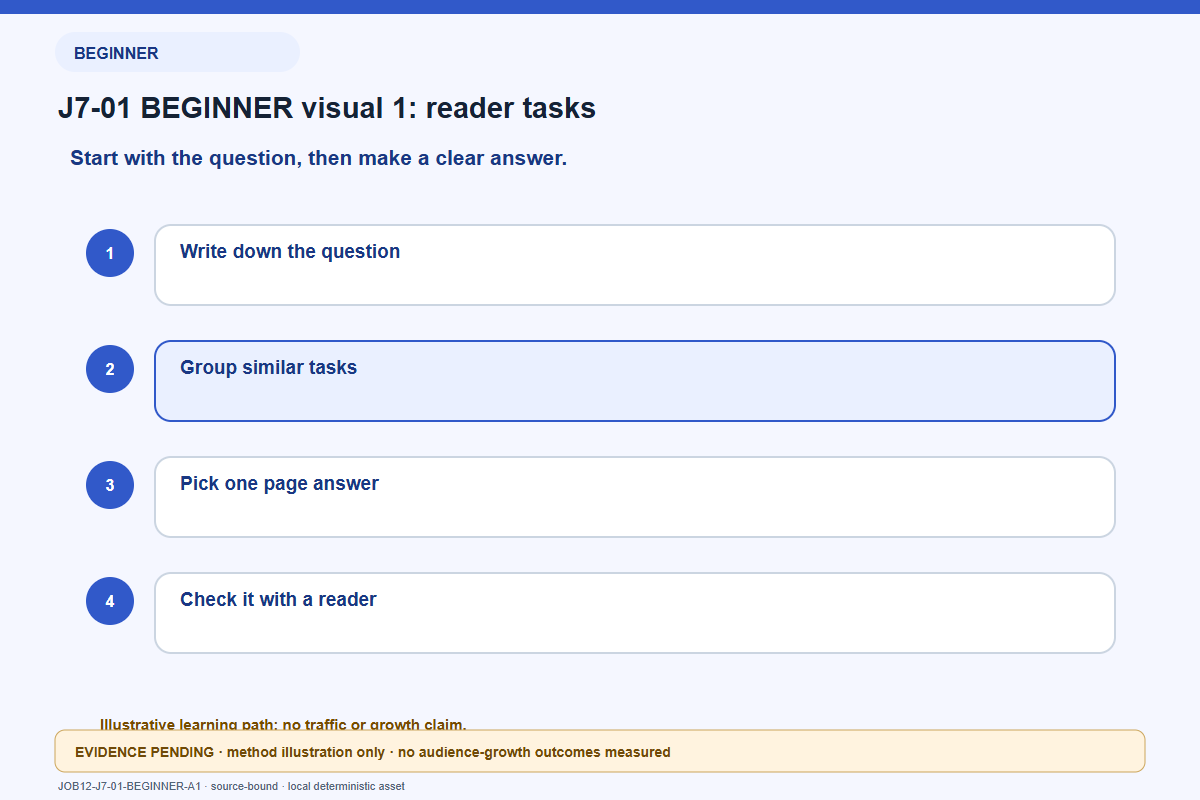
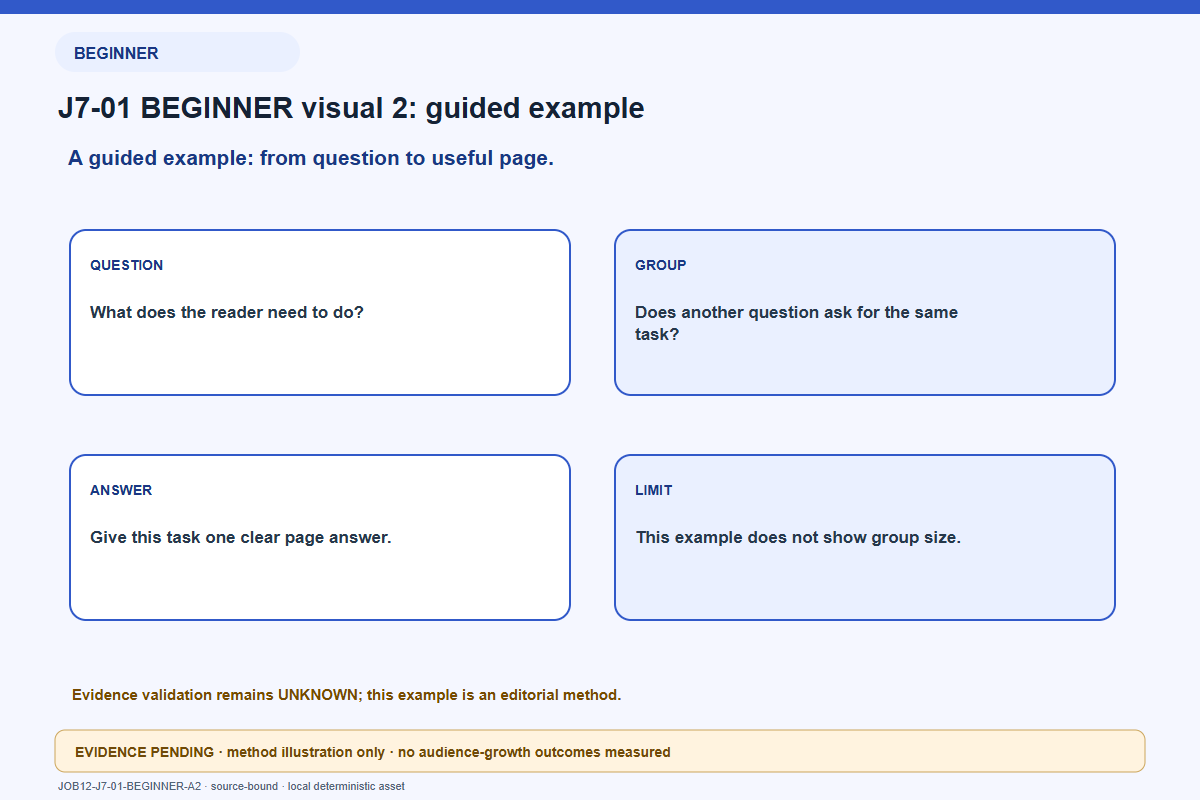
<strong>Quick answer:</strong> You can make one topic useful to more kinds of readers by answering genuinely different tasks clearly. This is a content-design method, not a guarantee that the audience will grow. It defines the key terms, shows a practical example and ends with a check you can run.
Before you begin
Introduce correct terms progressively and define them immediately. Confirm the approved source revision and use only evidence you are permitted to share. This published method guide does not promise audience growth.
Steps
STEP 1
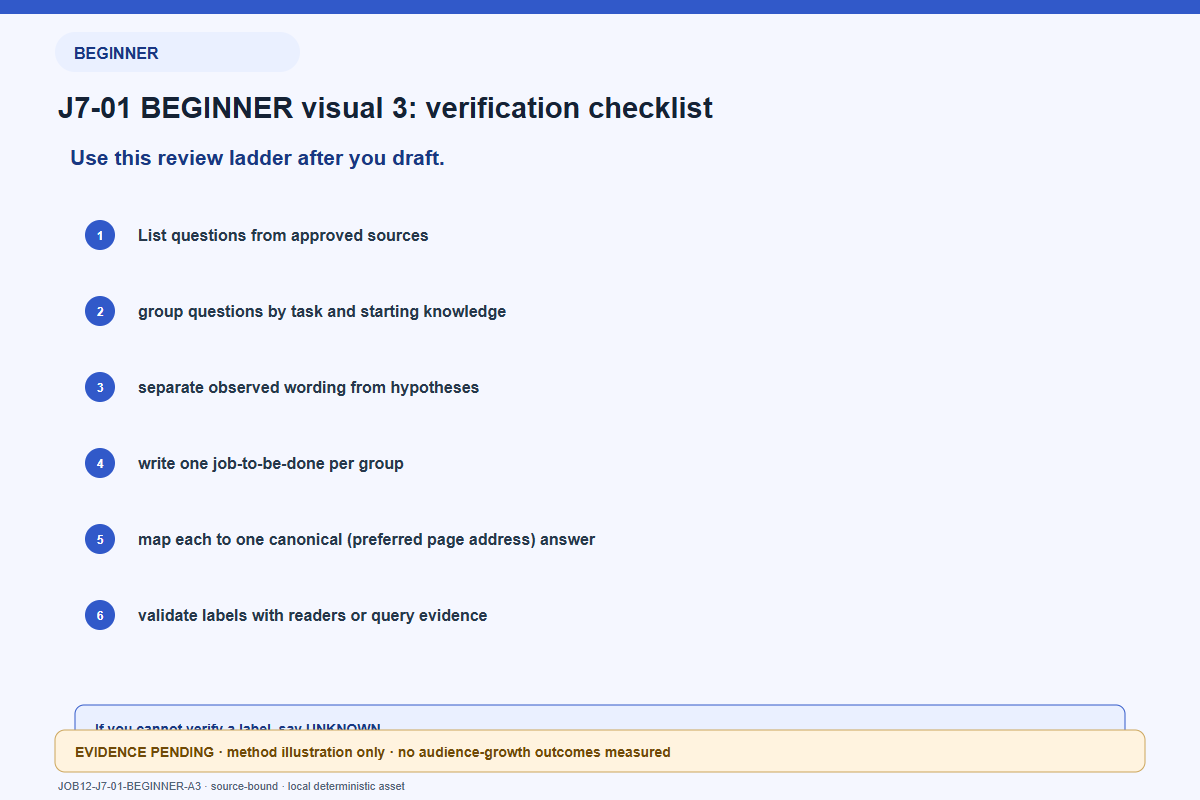
List questions from approved sources
STEP 2
group questions by task and starting knowledge
STEP 3
separate observed wording from hypotheses
STEP 4
write one job-to-be-done per group
STEP 5
map each to one canonical (preferred page address) answer
STEP 6
validate labels with readers or query evidence
Beginner working method
Work through the steps in order. Keep the new term, its definition and the example together; then try the verification check yourself before moving on.
Copy-and-paste template
Audience [ ] needs to [task]. Existing evidence: [source]. Starting knowledge: [ ]. Search wording observed: [ ]. Hypothesis only: [ ]. Canonical answer: [ ].Example
A newcomer needs a definition first; a practitioner may need a workflow. That distinction motivates two content treatments, not a claim that either group is larger.
Common mistakes
- Using one level’s metadata or example unchanged for all audiences.
- Adding a result, conversion, cost or ranking claim without its evidence.
- Letting an image, tooltip or automation hide the source, limitation or approval state.
How to verify
- Check each step can be followed in the target environment.
- Confirm title/meta/H1 and query intent are unique among siblings.
- Map factual claims to approved source IDs and preserve limits.
- If an audience-specific asset is attached later, verify its alt text, nearby text equivalent, source and limits.
Frequently asked questions
<strong>What should I prepare before I research audience needs before writing?</strong>
Start from this goal: Pick readers by the task they need to complete, not by invented demographics or guessed traffic. Define any new terms before applying the procedure.
<strong>Does following these steps guarantee the result for research audience needs before writing?</strong>
Authorized first-party question/query data and privacy review; analytics before any audience-size or demand claim.
Terms in this guide
Search intent
What someone wants to learn or do when they search.
Read the glossary entryAudience segment
A group of readers with a similar task or question.
Read the glossary entrySearch Console
A Google service that reports certain search appearance and traffic data for a site.
Read the glossary entry
Evidence, limits and publication status
No traffic, search-volume or audience-growth result is available from this design method. Treat all segment/query groups as hypotheses until supported by dated first-party data.
Do not turn missing evidence into zero. Classify numeric facts as MEASURED, OBSERVED, CALCULATED, ESTIMATED, MODELLED or EVIDENCE_REQUIRED.
Choose another level
Plain English · Beginner · Professional · Expert
Knowledgebase · Glossary · Methodology
Media for this pilot
No audience-specific image file is attached to this J7-01 pilot. The page uses responsive native HTML and CSS; any later media attachment must match its manifest hash, audience, revision and accessible alt text.
Evidence and transparency
Audience view: Beginner.
This is a method guide, not a measured audience-growth outcome. Traffic, ranking, conversion and audience preference remain unknown here.
EVIDENCE STATUS
EVIDENCE PENDING